Only when there remains only the noise of the bombs like .Then melody, that is that the music it will be concealed for the mankind.
DJ DemonAngel (23/01/2008)
Country : U.S.A Style : World Music , Jazz World , Blues
Tracklist :
01. Okra 02. Rain Shower 03. Natchez Shopping Blues 04. Your Lips 05. Harlem Country Girl 06. Zora 07. Young Mama 08. Bubber (If Only) (Olu Dara / Mayanna Lee) 09. Father Blues 10. Jungle Jay (Olu Dara / Nas) 11. Kiane
Origine du Groupe : Italia Style : Folk , Jazz World Sortie : 2012
From http://www.oldeuropacafe.com Somewhere between the melodic folk-inflected charm of Italian 60’s songwriters and the cabaret swoon of French chansonniers, Roma Amor’s new album is instinctively romantic and sophisticated. This album will seduce you with its summer-evening mellowness before breaking your heart with its beautifully sensual croon. Wonderful ballads and torch songs about love inspired by the epic, fatalistic rugged grandeur of Aznavour, Brel, Piaf, and 60’s Italian songwriters, though in a much quieter and more delicate setting. The album is sung in Italian with some French touches and the songs are from Roma Amor’s own harvest. The result isn't experimental or innovative, but an acoustic and intimate album for fans of well-crafted singer-songwriting.
Tracklist : 1. Occhi Neri 2. Mon Amour 3. Le Coeur Au Chaud 4. A Te Che Mi Vinci 5. Disertore 6. Euforia 7. La Concièrge 8. Mélancolie 9. Elle Est Seule 10. Sensualità 11. Fuoco Sottile 12. Madrigale
Avec une petite dizaine d'albums à son actif, et des collaborations prestigieuses (Ibrahim Ferrer, Omara Portuondo, ou encore Orlando Cachaito López), Roberto Fonseca fait figure d'incontournable de la musique cubaine actuelle. Sur son nouvel album « Yo », le pianiste de La Havane évolue toujours sur une base cubaine tout en s'envolant très souvent vers l'Afrique, en compagnie de Baba Sissoko au n'goni, Sekou Kouyate à la kora, ou la chanteuse Fatoumata Diawara. Ils sont d'ailleurs réunis sur la merveilleuse communion africo-cubaine « Bibisa ». On retrouve aussi le chanteur Assane Mboup, de l'Orchestra Baobab, sur « Quien Soy yo », et plus surprenant, Faudel « le petit prince du raï », qui pose ses mélismes sur le très free « Chabani ». Mais Fonseca peut aussi prendre un virage rock avec une kora quasi Sanatanesque sur « JMF », ou cinématique avec un orgue Hammond très 70's sur « Rachel ». On n'oubliera pas « Mi Negra Ave Maria », composé avec sa maman Mercedes Cortés, illuminé par le spoken word de Mike Ladd. Un album de grande classe, d'une fluidité remarquable pour notre plus grand plaisir !
Tracklist :
01. Roberto Fonseca - 80's (6:24)
02. Roberto Fonseca - Bibisa (4:33)
03. Roberto Fonseca - Mi Negra Ave Maria (5:21)
04. Roberto Fonseca - 7 Rayos (5:29)
05. Roberto Fonseca - El Sonadoresta Cansado (5:05)
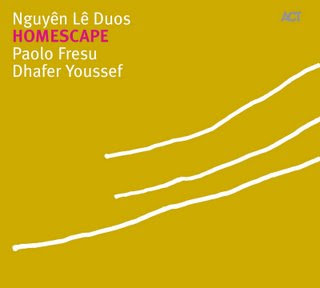
Where does jazz stop and world music start? The boundaries are getting more blurred by the minute. We’re all postmodernists now, and many musicians under fifty reflect a range of influences beyond those traditionally associated with their own core style. Some, like French-Vietnamese guitarist Nguyen Le, are so polyglot as to be practically beyond category.
Le started out down the cultural miscenegation road with his first band, the multi-ethnic Ultramarine, whose 1989 album, De, was named World Music Album of the Year by the radical French newspaper Liberation. He’s continued to mix it up ever since—prominent genre-benders he’s worked with include Miroslav Vitous, Trilok Gurtu, David Liebman, Paul McCandless, Peter Erskine and Mino Cinelu. In the late 1990s Le became increasingly interested in Maghrebi music, working with Algerian singers Safy Boutella and Cheb Mami, and in 1998 he brought Maghrebi and Vietnamese musicians together on the album Maghrebi & Friends.
None of this, however, can prepare you for the galaxy of sound sources on Homescape, a series of alternating duets with Sardinian trumpeter Paolo Fresu and Tunisian oud player Dhafer Youssef. Some of these sources are developed and explored, others are referred to only in passing, and they include—but aren’t limited to—post-Hendrix rock, Milesian harmon-mute free improv, Maghrebi trance music, Ellingtonia, ambient, a Papua New Guinea vocal choir (sampled and replayed backwards), Delta blues, Vietnamese folk tunes, flamenco, Iranian modes, a Sardinian choir, Australian aboriginal ritual music, French chanson, Gregorian chant, and Indonesian gamelan/gong music.
Guitars, trumpet/flugelhorn and oud aside, the music is generated by loops, samples and overdubs, and the entire heavily post-produced album was recorded and mixed in Le’s Paris apartment – since 2003, his friends and neighbours Fresu and Youssef have been dropping by to home-record. The duets with Fresu are typically in free-improv mode (the exception being Duke Ellington & Billy Strayhorn’s lovely “Chelsea Bridge”), while the Youssef duets tend to be song or structure-based.
In the main sunny and joyful, though not without some darker and more abrasive moments, the fifteen tracks—average length three minutes, a handful six or seven—resemble a series of round-the-world postcards sent by Le, who mixed and post-produced everything solo, to his collaborators. As a soundtrack to an evening communing with the big bamboo, the exotic and the very exotic drifting in and out of the mix, it’s rich, colourful and beguiling.
Tracklist :
1 - Stranieri (Paolo Fresu / Nguyên Lê) (06:00)
2 - Byzance (Dhafer Youssef / Nguyên Lê) (04:25)
3 - Muqqam (Dhafer Youssef) (02:44)
4 - Mali Iwa (Nguyên Lê) (06:27)
5 - Zafaran (Dhafer Youssef / Nguyen Le) (06:02)
6 - Domus de Janas (Paolo Fresu / Nguyên Lê) (02:18)
7 – Kithara (Dhafer Youssef) (02:18)
8 - Chelsea Bridge (Billy Strayhorn) (03:00)
9 - Safina (Dhafer Youssef / Nguyên Lê) (03:27)
10 - Des Pres (Paolo Fresu / Nguyên Lê) (02:19)
11 - Thang Long (Nguyên Lê) (05:33)
12 - Neon (Paolo Fresu / Nguyên Lê) (03:12)
13 - Mangustao (Dominique Borker) (07:26)
14 - Lacrima Christi (Paolo Fresu / Nguyên Lê) (03:14)
Remember Shakti is a quintet which combines elements of traditional Indian music with elements of jazz. The band consists of English guitarist John McLaughlin, Zakir Hussain (tabla), U. Srinivas (mandolin), Shankar Mahadevan (vocals), and V. Selvaganesh (kanjira, ghatam, mridangam), who are all of Indian descent. The band's name is derived from John Mclaughlin's acoustic Indian fusion band Shakti which was active in the 1970s. This band consisted of John McLaughlin, Zakir Hussain, L. Shankar, T.H. "Vikku" Vinayakram, and R. Raghavan. The word Shakti translates in Sanskrit to "female creative power" or "goddess."
meStissage is the sixth studio album by Cape Verdean Teofilo Chantre. As Cesaria Evora s appointed composer, Chantre has penned many beautiful songs such as Ligereza, Um Pincelada and Crepuscular Solidão. His work is characterized by a strong melodic sense and harmonic sophistication that blends in a kind of swinging Creole jazz. meStissage features Marc Estève as well as a guest appearance by Bernard Lavilliers who, after covering a Teofilo Chantre song on his latest release, joins him here for a duet.
Although not quite as memorable as its predecessor, this is still one of the finest...
Omara Portuondo made her solo debut for World Circuit in 2000, three years after her show-stealing cameo with Compay Segundo singing 'Veinte Años' on the block-busting Buena Vista Social Club album.
Her solo career actually dates back to 1959 and she's done numerous records, but only World Circuit have given The 'Buena Vista sista' the red carpet treatment and lush settings she really deserves.
Buena Vista Social Club presents Omara Portuondo found her in the very capable hands of musical director Demetrio Muñiz and was a tough act to follow. This time around, World Circuit founder and producer Nick Gold has chosen to work with Muñiz again as well as Brazilian producer Alê Siquiera, known for his work with Carlinhos Brown and Caetano Veloso. Once more, the songs are mostly vintage pieces from the Great Cuban Songbook.
The closing 'Casa Calor' is a strangely stirring retro-futurist offering by Brown, which sounds almost like it might have fallen off the track-listing from last year's wonderful joint album by Ry Cooder and Manuel Galbán. The former Los Zafiros guitarist maintains an uncharacteristically discreet presence on rhythm guitar throughout much of 'Flor de Amor', even though both 'Hermosa Habana' and 'He venido a decirte' (one of Omara's finest vocals) were originally performed by Los Zafiros.
It's the guitars and their relations that really shine, most notably in the solo by Brazilian player Swami Jr. on the upbeat 'Mueve la cintura mulato'. There's a touch of laoud from Barbaríto Torres, and plenty of subtle licks from Irakere's electric guitarists Carlos Emilio and Jorge Chicoy.
Lastly, tres player Papi Oviedo, (who's been an entertaining live sidekick for the singer in recent years) backs her alone, and very tastefully, on 'Amorosa Guajira'. It's a sharp contrast with the sweeping strings and cooing backing vocals that feature in most of the other lush arrangements, along with plenty of demurely noodling clarinet by Javier Zalba.
Though she's capable of Shirley Bassey-style belters, the focus is on the more intimate aspect of Omara's work, with danzones, boleros, and guajiras dominating the fourteen tracks.
Maybe it's the lack of duets, the absence of the late great Rubén González, the material or its sequencing, but somehow, gorgeous as it is, 'Flor de Amor' isn't quite as memorable as its predecessor. That said, this is still one of the finest Cuban albums you'll hear this year.
Follow-up to 2010's acclaimed EP Addis-Abeba, Mercato is the debut album by Swiss band Imperial Tiger Orchestra, the finest connoisseurs and grooviest performers of Ethiopian music from the Golden Age.
Raphaël Anker, trumpet player from Geneva, one day decides to gather musicians for a live performance revisiting the golden age of Ethiopian music. It's 2007, and the experience is so memorable that the one shot happening becomes a band: Imperial Tiger Orchestra.
Consisting of members with very diverse backgrounds (free jazz, noise experimentations, contemporary music, twisted pop) the Orchestra tests the grounds with an EP and a 7" breaking the boundaries of genres followed by a trip to Addis-Abeba where they perform with local luminaries and learn about the large diversity of Ethiopian music. A life-changing experience which brings them back to the studio for their debut album: Mercato.
Overseen with flair by Ethiopian music expert Jeoren Visse, Mercato is a mesmerizing re-interpretation of Ethiopian music's golden age mixed with the digitalized themes that appeared in the 80s and filtered through the eclectic influences of the Orchestra. It's a fascinating retro-futuristic piece of music, close yet totally different from the songs that inspired the band. It's progressive Ethiopian rock!
Whether saluting Mahmoud Ahmed on "Lale Lale", re-interpretating the classic wedding theme "Shinet", or taking Martha Ashagani's "Zoma" to new heights, the Orchestra always does it with its unique vision while honoring the Ethiopian originals. Thunderous rhythms and feverish hooks, down tempo moments and fast paced epiphanies, electronic sounds and ambient nirvanas, Mercato explores multiples paths and never loses its warm groove. A winter Mercato sure to bring fire to stages this summer!
For fans of KOKONO N1, MULATU, MAHMOUD AHMED, ETHIOPIQUES SERIES,...